Tuesday, 13 November 2012

Allocution 9 November 2012: 'Deification and Grace'

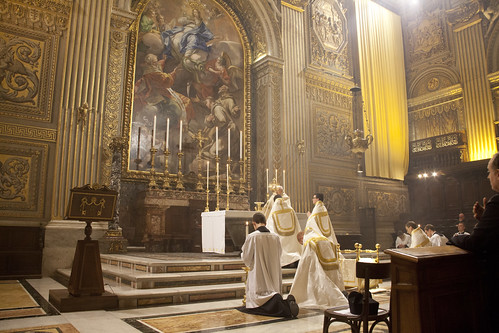
Our Lady of the Rosary, Blackfen, before the Spiritual Exercises
As an Anglican my spiritual director was the superior of a small enclosed contemplative community called the Monastery of the Holy Trinity, Crawley Down, and so not far from Worth Abbey. The late Fr Gregory was much influenced by the theology of the Orthodox Church. I learnt from him and from the books that I read during the many retreats I spent there about theosis or deification. This is the central theme of Orthodox theology, indeed for Orthodox Christians it is the Gospel, as the following quotation from the October 2008 edition Orthodox Outlook (a Popular Pan-Orthodox magazine as it calls itself) makes clear. Here are the editors explaining the purpose of the Incarnation. They write: ‘It is an invitation from our Creator to partake of His nature and find unending joy and peace and fulfilment in His kingdom.’

That sentence is an editorial summary of three quotations, two from patristic sources and one from Holy Scripture. ‘In his unbounded love, God becomes what we are, that He might make us what He is’ is from St Irenaeus; they also quote St Athanasius, ‘God became human so that we might become divine.’  And they conclude with 2 Peter 1.4: ‘through them (viz, the ‘glory and power’ of God) you may come to share in the divine nature.’ 

We can see from the above that theosis does not just belong to the theological heritage of Orthodoxy for both St Irenaeus and St Athanasius are fathers of the undivided Church who wrote well before the schism of 1054 when the name of the pope was removed from the diptychs or intercession list of the church of Hagia Sophia in Byzantium. And the text of the second epistle of St Peter could not be clearer: the purpose of the incarnation is that ‘you may come to share in the divine nature.’ So how is it that we Catholics, Christians in communion with the See of St Peter, hear so little about deification? Why doesn’t the Magisterium teach about deification? After all, not only is it both scriptural and traditional, it is also vital to understanding the purpose of the Christian life, and not just for understanding but for living it! 

Although there is no entry for deification in the Catechism, we do find it referred to in Part 3, Life in Christ and specifically in the section entitled Grace: ‘The grace of Christ is the gratuitous gift that God makes to us of his own life, infused by the Holy Spirit into our soul to heal it of sin and to sanctify it. It is the sanctifying or deifying grace received in Baptism.’ (CC 1999) Two paragraphs before this definition we read the following which makes even clearer the intimate connection between the Catholic teaching on grace and the Orthodox understanding of theosis: ‘Grace is a participation in the life of God.’ And the paragraph goes on to explain: ‘It introduces us into the intimacy of Trinitarian life: by Baptism the Christian participates in the grace of Christ, the Head of the Body. As an ‘adopted son’ he can henceforth call God “Father”, in union with the only Son. He receives the life of the Spirit who breathes charity into him and who forms the Church.’ (1997) Grace is ‘the free and undeserved help that God gives us to respond to his call to become children of God, adoptive sons, partakers of the divine nature and of eternal life.’ The matter could not be clearer: although East and West have a different vocabulary, the theology is the same. Theosis or deification is the same as sanctifying grace. 

In the remainder of this talk I want to speak about sanctifying or deifying grace for, although it is given to us above all through the Sacraments beginning with Baptism, it is so important a theological topic that it should not be assimilated into sacramental theology. Indeed meditation on what it is we receive in the sacraments will enable us to appreciate better the nature of the sacraments themselves. Precisely such a meditation on grace is to be found in the pages of the work of Fr Matthias Scheeben (1835-1888) called The Glories of Divine Grace. 

It is subtitled A Fervent Exhortation to All to Preserve and Grow in Sanctifying Grace. Thus it is addressed to all the faithful as of course it must be since, as we have seen, the life of sanctifying grace begins at Baptism. The title of the first chapter is How Deplorable it is that Men Should Have So little Regard for Grace. I was reminded when I read that of the comment made in a talk I recently heard by Fr Andrew Pinsent, the co-author of the Evangelium course which I used in my Anglican parish in preparation for the reception of my small Ordinariate group into the full communion of the Catholic Church. He asked the summer conference of that movement comprising young Catholics how many had heard a sermon on grace. Apparently over two thirds had not. Judging by the reproach in the title of the first chapter of The Glories of Divine Grace, perhaps Fr Scheeben faced a similar situation. And so Fr Scheeben sets himself the task of explaining why we should have regard for grace: ‘By grace the soul is received into the bosom of the Eternal Father and, together with the Divine Son, participates in the nature of the Father on this earth, and in His glory in the life to come.’ He then tells us the views of two of the great doctors of the Western Church on this subject: ‘St Thomas teaches that the whole world and all it contains is of less value before God than the grace of a single soul… And St Augustine maintains that the whole Heaven together with all the Angels, cannot be compared with this grace.’ Fr Scheeben then compares the soul who rejects God’s grace with the Israelites after the exodus who ‘despised the manna God gave them on the journey… and longed again for the fleshpots of Egypt.’ He explains that ‘the manna was a type of grace – a figure of our nourishment on the road to Heaven’ while ‘the Promised Land was a figure of Heaven’. But why do we frequently disregard grace? Why are we often like the Israelites who longed for ‘the fleshpots of Egypt’? Fr Scheeben answers: ‘because we permit ourselves to be too deeply impressed by our senses with transitory things and because we have but a superficial knowledge of lasting, heavenly riches.’ So what is the remedy for this fascination with ‘the changes and chances’ of this passing world? ‘We must draw as near as possible to the overflowing and inexhaustible fountain of divine grace.’ And how do we do that? Fr Scheeben answers paraphrasing St John Chrysostom: ‘he who admires and praises grace… will zealously and carefully guard it.’ He then invites the reader to begin with him ‘the praise of the glory of his grace’, words from St Paul’s Epistle to the Ephesians (1.6). The chapter ends with five beautiful prayers addressed respectively to the three Persons of the Most Holy Trinity, Blessed Mary Mother of God and the Holy Angels. And that is the nature of this remarkable book: it is a work of praise and prayer. It is not just about its subject but is animated by it. For Sanctifying Grace, truly considered, must inspire praise and prayer. 

One of the observations Fr Pinsent made in the talk I referred to earlier regretting the virtual disappearance of grace from the vocabulary of Catholics is that it is much less common these days to hear Catholics refer to themselves as being or not being in ‘a state of grace’. If we are to recover this language then we must be able to give some guidance on that issue. The Catechism begins by reminding us of an all-important proviso: ‘Since it is supernatural, grace escapes our experience and cannot be known except by faith. We cannot therefore rely on our feelings or our works to conclude thereby that we are justified or saved.’ This is the same point made in the Psalmist’s prayer, ‘But who can discern his errors? Cleanse me from my hidden faults.’ St Paul too declares; ‘I do not even judge myself. I am not aware of anything against myself, but I am not thereby acquitted.’ But taking this as read, St Thomas says we may conjecture that we are in a state of grace or have God’s favour from the following three signs: 1. If we find contentment and delight in the thought of God, i.e., in reflecting on His goodness and loving care of us, in uplifting our minds and hearts in prayer, and in frequenting the Sacraments; 2. if we despise earthly things, i.e., if we are detached from pleasure and riches, not desiring them for their own sakes but for use in the service of God; and 3. if we are not conscious of any unforgiven mortal sin.’ (S.Th., 1.ii, q 112, a. 5) We might also make our own the response of Joan of Arc to a question posed by the judges at her trial and designed to trap her. Asked whether she was in God’s grace she replied: ‘If I am not, may it please God to put me in it; if I am, may it please God to keep me there.’ (quoted in the Catechism 2005) 

Luther and his fellow Reformation polemicists, in their attack on the sacramental system of the Catholic Church posed a false alternative. We are saved, they said, either by faith or by works and they alleged further that the Church taught the latter, a kind of self-help religion Thus did they think to claim faith for their own schismatical movement. However, setting faith against works in this fashion is mistaken, and we can see why if we attend to the meaning of Sanctifying Grace. The teaching of the Church at the time of the Reformation, a teaching which has not changed, is that faith as one of the supernatural or theological virtues which has its source in Sanctifying Grace. So Fr Scheeben describes these virtues as ‘the royal retinue of Sanctifying Grace’. They follow in its train. He writes of Faith that although it is a ‘human act, freely made and reasonable… no-one can make such an act unless supernatural grace – which is denied to no-one – be given him by God… the ability to make an act of faith must be given by God.’ And this is exactly the same with the works or actions of the Catholic. Fr Scheeben quotes St Francis de Sales in his Treatise on the Love of God: ‘The Holy Ghost acts in us, through us and for us so admirably, that though our actions are our own, they belong more to him than to us. We perform them in Him and by His direction, while He performs them in us.’ Fr Scheeben thus asks, ‘What can give such immense value to our troubles and sufferings, which are in themselves but trifles?’ and he answers, ‘Dipped in grace, the chaff becomes gold… every good work, though little in itself, becomes through grace, of very great value, capable of purchasing for us the greatest treasure, Heaven and God Himself.’ 

Thus Sanctifying Grace is our deification; the words are different but the divine reality is the same. And Fr Scheeben explains the affinity in a chapter entitled significantly The Participation in the Divine Nature Effects a Supernatural Similarity to This Nature. He writes of ‘(t)he participation in the Divine Nature… which we enjoy by grace’ and explain that ‘grace is, according to St Paul, a new creation and the foundation of a new immovable kingdom (Eph 2.10, Heb. 12.28).’ Thus the two pillars of the Church, St Peter and St Paul, concur. The former speaks of deification and the latter of Sanctifying Grace, but the doctrine is the same. Fr Scheeben uses an Old Testament image: ‘We are called to dwell in the tabernacle of God’s eternity… Here our eternal existence is as secure as God Himself; here we need fear neither death nor destruction’. So ‘why’, he asks ‘do we rely on our own nothingness and pursue other things which are as vain and transitory as our life here below?’ He answers by relating the 
doctrine of sin to the theme of deification:
The sinner desires – as did our first parents, and the devil himself – ‘to be as God’. In truth, God Himself wills that we should be as He, but not without Him, not outside Him, not in opposition to Him. He does not will that we should make ourselves as other gods… He wills that we should be as He, but in His bosom, in His heart. He wills it to be through Himself and in union with Him, as in the case of His Divine Son, who is not another God, but the same with the Father.
That is also the doctrine which Fr Gregory of Crawley Down taught during the fifty years of his life as a contemplative. And he did so in the belief that Anglican patrimony was not something idiosyncratic but was the same as what he called ‘the Great Tradition’, the teaching of the undivided Church of East and West.

Fr Simon Heans

Sunday, 21 October 2012

Allocution 12 October 2012: 'Judgement'


In the first allocution, I talked about some modern approaches to eschatology (the last things.) Sometimes these writers have played down the importance of individual eschatology. I suggested that communal eschatology – the general judgement and the general resurrection – are closely intertwined with our individual eschatology and that I would therefore address the topic of our own four last things without feeling guilty about doing so.

Although not a defined doctrine of the Church, the particular judgement is considered to be sententia proxima fidei, that is, a doctrine regarded by theologians generally as a truth of the faith even though it has not yet been finally promulgated by the Church. The particular judgement is especially implied in the teaching of Pope Benedict XII in Benedictus Deus where he affirmed that the saints experience the beatific vision immediately after death, those who die in mortal sin immediately descend to hell, and those in venial sin immediately begin their purification in purgatory. The Catechism of the Catholic Church adds weight to the common teaching of theologians when it affirms:

Each man receives his eternal retribution in his immortal soul at the very moment of his death, in a particular judgment that refers his life to Christ: either entrance into the blessedness of heaven – through a purification or immediately, – or immediate and everlasting damnation. (1022)

The great Dominican theologian, Garrigou-Lagrange puts it like this:

The analogy between divine judgment and that of human justice brings with it resemblances, but also differences. Judgment before a human tribunal involves three steps: examination of the case, pronouncement of the sentence, and the execution of that sentence.

In the divine judgment the examination of the case is instantaneous, because it needs neither the testimony of witnesses, for or against, nor the least discussion. God knows by immediate intuition, and at the moment of separation the soul knows itself without medium. It is enlightened, decisively and inevitably, on all its merits and demerits. It sees its state without possibility of error, sees all that it has thought, desired, said, and done, both in good and in evil. It sees all the good it has omitted. Memory and conscience penetrate its entire moral and spiritual life, even to the minutest details. Only then can it see clearly all that was involved in its particular vocation, for instance, that of a mother, of a father, of an apostle. (Garrigou-Lagrange, R. Life Everlasting. Part 2.10.)

St Alphonsus relates the following story:

The thought of judgement inspired the venerable Juvenal Ancina, Priest of het Oratory, and afterwards Bishop of Saluzzo, with the determination to leave the world. Hearing the Dies Irae sung, and considering the terror of the soul when presented before Jesus Christ, her Judge, he took, and afterwards executed, the resolution of giving himself entirely to God.

The Dies Irae can indeed serve us well as a meditation on the particular judgement. It is a significant part of the traditional Requiem Mass. Nowadays we struggle to convince people that the Requiem Mass is not simply a celebration of the life of the deceased person but also a sacrifice offered for the forgiveness of their sins. The traditional texts also encourage us to meditate upon the last things. I will take just a few verses to illustrate how we can prepare for the judgement that we will inevitably undergo the moment that we depart this life.

Iudex ergo cum sedebit,
quidquid latet apparebit:
nil inultum remanebit.

Therefore when the judge shall sit, whatever is hidden will be made plain: nothing will remain unrequited.

Perhaps in the past we have concealed a sin in confession. Perhaps we have grown in virtue and now realise that things which we excused ourselves in the past were in fact mortal sins. It is a good practice for us occasionally to make a general confession – not scrupulously or too often, but on the occasion of a change in our lives, or on a special retreat when we are determined to give ourselves more completely in the service of God, we can choose a suitable time, or make an appointment, to make a general confession of all the major sins and faults of our life. This need not take long: when people tell me the old joke (as they so often do) “Oh Father you can’t hear my confession, it would take all day”, I always reply “No, the confession can be quite brief, it is the penance that will take the rest of the week.” In fact, we will never do sufficient penance for our sins, but the more that we manage to do in this life, the less onerous will be our judgement.

Quid sum miser tunc dicturus?
quem patronum rogaturus?
cum vix iustus sit securus.

What shall I, a wretched man, say then? What patron shall I call upon when even the just is scarcely safe?

What shall I say then? This question should prompt us to say all that we need to say now, in this life, while there is still time for repentance and conversion of our lives. Then, it will be too late. Now, God gives us time. Our time is so precious that we should not waste a moment of it.

Whether at prayer, at work or at recreation, every moment of our lives should be lived according to God’s will, offered for Him and not for our own comfort. The time that we spend in recreation from our labours should be seen always as an act of charity to others, considering their needs, not our own, even if we have to spend time on our own relaxing in some activity that makes us better able to serve God and show charity to others.

Consider the repentant thief. (Lk 19.40-43) He had but a short time to hang upon the cross next to Jesus before Our Lord, tortured more severely than Him, gave up the ghost. In a few moments he expressed his faith in the Lord’s power to save and was granted by Our Lord that he would be in paradise that very day. His supremely profitable use of a few moments should prompt us to the prayer:

Oro supplex et acclinis,
cor contritum quasi cinis:
gere curam mei finis.

I pray, suppliant and prostrate, with heart ground down as ashes: have care for my end.

Contrition is the tearing of our heart in shreds at the outrage that we have done to Our most loving Lord, at the part that we have played by our sins in gouging out the Holy Wounds which we venerate. This may come from a fear of hell or, as is more likely today when people forget the reality of hell, a sheer disgust at our weakness and at having let ourselves down.

This is what we call imperfect contrition. In God’s infinite mercy, when allied with sacramental confession, it is enough. God accepts even this imperfect contrition as availing for the complete forgiveness of our sins and the opening of the gates of heaven.

Much better is that perfect contrition which comes from the love of God. Meditation on the passion of Christ and upon His most holy wounds is a sure way to excite in ourselves that perfect contrition which mourns because we have offended God. Pondering the sufferings of Christ helps us in our weakness to see concretely and in physical terms what our sins, even the least venial sin, does to the incarnate body of the living God come down to visit us.

We will shortly be celebrating the commemoration of All the Souls of the Faithful Departed. We should also try to visit a cemetery during the first eight days of November to gain the plenary indulgence as well as making the act of charity of praying for the repose of the souls of the faithful departed, especially those for whom nobody else is praying. These pious exercises, as well as attending Requiem Masses and arranging for Masses to be said for the dead, are primarily for the benefit of the holy souls.

However they also benefit us, not only generally as devout practices of Catholics, but also directly because of the prayers that are part of the traditional round of the Churches liturgy. A final prayer that is often said also in the Novus Ordo is a salutary reminder to us of how we should be affected whenever we pray for those who have died:

Grant, O God that while we lament the departure of this your servant, we may always remember that we are most certainly to follow him. Give us the grace to prepare for that last hour by a good life, that we may not be surprised by a sudden and unprovided death but be ever watching, that when you call, we may enter into eternal glory. Through Christ our Lord. Amen.

May the Lord indeed give us that grace to live a good life of prayer, penance and works of mercy. And may he judge us mercifully when we appear before Him.

Wednesday, 3 October 2012

Homily 14 September 2012: Glory in the Cross


And I, if I be lifted up from the earth, will draw all things to myself. (Jn 12.32)

Usually when today’s Introit is set out in a text, the reference is given to Galatians 6.14:
mihi autem absit gloriari nisi in cruce Domini nostri Iesu Christi per quem mihi mundus crucifixus est et ego mundo

(But God forbid that I should glory, save in the cross of our Lord Jesus Christ; by whom the world is crucified to me, and I to the world.)

In fact our text in the Liturgy is stronger than the text of St Paul. We are told:

Nos autem gloriari oportet in Cruce Domini nostri Jesu Christi in quo est salus, vita et resurrectio nostra per quem salvati et liberati sumus (We should glory in the Cross of Our Lord Jesus Christ in which there is our health, life and resurrection through which we are saved and set free.)

In other words, it is not that we should not glory in anything else, but that we must glory in the cross.
Our feast is closely associated with the finding of the Holy Cross by St Helena, and with the great triumph of the Cross in the liberation of Christians within the Roman empire. In his commentary on today’s feast, the Abbé Gueranger told of Constantine’s vision of the cross and said:

A few months later, October 27, 312, all the idols of Rome stood aghast to behold, approaching along the Flaminian Way, beyond the bridge Milvius, the Labarum with its sacred monogram, now become the standard of the imperial armies. On the morrow was fought the decisive battle, which opened the gates of the eternal City to Christ, the only God, the everlasting King.

Constantine’s adoption of the cross as a symbol was a radical transformation in Roman attitudes to the Cross. Long before Christ, Plautus and Terence used expressions like “I in crucem” (Go to the cross) as a way of saying something like “Go to hell!” the Alexamenos graffito carved in plaster on a wall near the Palatine hill has a crude picture of a donkey on the cross, a man in an attitude of prayer and the inscription probably meaning “Alexamenos worships God.” One soldier taking the mickey out of another’s faith shows his God as a donkey.

That soldier had to glory in the cross in spite of ridicule. Today people lose their jobs because of wearing a cross. The cross was central to the overturning of the fortunes of the Christians from a time of merciless persecution under Diocletian to their liberation just two years after his death. The cross must also be at the heart of our resistance to the encroachment of secularism on the freedom of Christians in Western countries which is growing day by day. We aren’t being thrown to the lions but the unborn and the elderly are being despatched in greater numbers that Diocletian could manage, and Christians are increasingly constrained if they do anything effective about it.

In the Sodality of the Five Holy Wounds, we glory in the cross and take consolation in the sweet and saving power of the sufferings of Christ for our salvation. As well as being justly bold and proud in our faith, we must embrace the cross in daily life, both by chosen penances and daily mortification and by the acceptance of those penances that God sends to us in His providence. If we can learn to bear with and even rejoice in those daily trials, we will have a small glimpse of the happiness of the Holy Martyrs who were unshaken by their torments but worshipped, trusted and gloried in the Cross of our Holy Saviour.

Monday, 10 September 2012

Sodality Events this year 2012/13

A new year is upon us and the first event will be the Sung Mass on Friday 14 September 2012, the Exaltation of the Holy Cross, at 20:00 at Our Lady of the Rosary, Blackfen. The Mass will be followed by a shared supper. All are welcome to this celebration, which will also be the fifth anniversary of Summorum PontificumDeo gratias!

The meeting dates are now fixed for the year and are listed in the sidebar.

We look forward to seeing you at some or all of our events.

Monday, 13 August 2012

Temptation and the Five Holy Wounds

St Romual delivered from evil
There is a wonderful article at Vultus Christi about the link between temptation and the Five Holy Wounds. The author, Dom Mark Daniel Kirby, is Prior of Silverstream Priory, under the patronage of Our Lady of the Cenacle, in Stamullen, County Meath, Ireland.

Daniel Mitsui

Chicago-based Catholic illustrator and artist, Daniel Mitsui, has included news of his new logo for the Sodality in his latest newsletter. You can read the newsletter here: . Catch up with Daniel's latest pursuits at his blog: The Lion and the Cardinal.

Monday, 16 July 2012

Allocution 13 July 2012: 'Death'

El Greco (and workshop), St. Francis & Br. Leo meditate
On Ash Wednesday, the priest says “Remember man that you are dust, and unto dust you shall return.” At the beginning of Lent, we are reminded of our mortality. We also remind ourselves of it every day when we say the Hail Mary and ask Our Blessed Lady to pray for us both now and at the hour of our death. The idea of meditating on our own death should not therefore be something surprising to us but nowadays, even the idea of a priest giving an allocution on the subject of death might be thought odd.

It is rightly said that our culture has a strangely contradictory approach to death. On the one hand, children from a young age see portrayals of death in their hundreds and thousands in films and games; on the other hand, nobody wants to talk about real death or to be near a dying person. People try to make funerals into the “Celebration of the life of” the person who has died while at the same time fearing the trauma of the funeral itself, often without being able to articulate why.

As an antidote to this, there are many services aimed at helping people to cope with death. Care of the dying is often notable for professional compassion and sensitivity, and bereavement counsellors are on hand to help those who have lost a loved one. Death often takes place under sedation so that what our forefathers called the “agony of death” is seldom seen.

Much of this is very much to be welcomed as an application of Christian medical care (the hospice movement is now moving away from its Christian origins but it is a Christian thing to care for the dying.) What is very often missing, though, is the most important thing about death: that it is the gateway to eternity.

Through much of the Old Testament, the prospect of eternal life was not clearly understood or taught. Even in the time of Our Lord there was still a debate raging between the Pharisees and the Sadducees over whether there was a resurrection from the dead. Our Lord Himself, in his own words recorded in the Gospels, provides for the first time in history a definite, insistent, clear teaching on the reality of eternal life and the possibility of eternal death.

Fulfilling and perfecting the hints and gradual realisation of the later literature of the Old Testament, Jesus spells it out for us plainly for the first time. He tells of the man who built bigger barns to store his grain: the Lord said to him that his soul would be required of him that night. He says that we should store up treasure in heaven; He tells us of the foolish virgins who were not ready for the master to arrive; He describes the banquet which many refused to attend; He warns of salvation and damnation and the judgement that will be given between the sheep and the goats.

Unless we are to pass over major portions of the teaching of Our Lord in the gospel, we have to admit that preparation for our death and eternal life was a central part of the teaching of Jesus Himself. If we are to be Christians we cannot possibly ignore these words from the very Word of God Himself.

Throughout the ages, the Saints have indeed preached this message of Our Lord. It is only in recent years that we have shied away from it. This can only be through a lack of faith in the teaching of Our Lord that there is an eternity after death for which we should prepare. The secular approach to death with its exclusive focus on comfort during this life may be an influence on us. We may also be swayed by an incomplete Christian preaching which speaks only of the resurrection and eternal life without thought to the fact that there may be an alternative. We also tend to think exclusively of the death of others and our quite proper Christian duty to help them as a corporal work of mercy, without thinking about the certainty of our own death and the need to prepare for it.

St Alphonsus often used to say in his preaching that God promises us His grace, but He does not promise us tomorrow. He was concerned to concentrate the minds of his hearers on the urgent need to change their lives now by taking up or resuming the practice of their faith. In his time, most people still believed in the Gospel – our evangelisation may need to start again with St Paul and his efforts to convince the gentiles of the true God. But for ourselves, trying to live the Christian faith more deeply, St Alphonsus can help us to get back to the basics of our Catholic faith and practice.

As he said, at the time of our death, nothing will comfort us except to have loved the Lord Jesus. If a man is worth twenty billion pounds it will be no use to him; if he has five doctorates, they will not matter; if he has a powerful position in the government, it won’t help. All that will matter is the state of his soul.

We may not have achievements like that – still we easily treasure things on earth: whether money, influence, popularity, a collection of fine objects, a nice house, a car we feel proud of, a position we have worked for, at our death it will all be worth nothing whatsoever in itself. All of these things will be of value only if they have been used by us to love the Lord Jesus and only in so far as they have been used by us to love the Lord Jesus. Even then, they will only be incidental to what our soul has become through the influence of God’s grace in the measure that we have loved the Lord Jesus.

It is common nowadays to see on the edges of towns, places where people can store the superfluous things that they can no longer fit into their houses. It is salutary for us to remember that the whole lot is, in the end, superfluous except in the measure that it has brought us closer to Jesus and to the eternal life that He has won for us.

The fact that there is an eternal life, that it is not an automatic entitlement, that it depends on how we live here and now, and specifically how we live our faith, especially given that we have the great gift of knowing the teaching of the Catholic Church, means that thinking of our own mortality from time to time and preparing for the most momentous event of our entire life, is not a morbid refusal to live in the real world but the most practical commonsense.

I mentioned that the Hail Mary reminds us daily of our own death. A popular prayer of commendation is also a good preparation for us:
Jesus, Mary and Joseph, I give you my heart and my soul. Jesus, Mary and Joseph, assist me in my last agony. Jesus, Mary and Joseph, may I breathe forth my soul in peace with you. Amen.
St Alphonsus helps in his meditations on the Stations of the Cross. Notice how often modern meditations on the Stations focus on the sins of other people, perhaps elsewhere in the world. St Alphonsus brings us home again. Remember the prayer for the fifth station where Simon of Cyrene carries the Cross of Our Lord:
My beloved Jesus I will not refuse the cross: I accept it, I embrace it. I accept in particular the death that is destined for me with all the pains that may accompany it. I unite it to Your death, I offer it to You. You have died for love of me; I will die for love of You. Help me by Your grace.
Another prayer of the same saint refers to our own devotion to the Holy Wounds of Our Lord:
My Jesus, I embrace thy Cross and kiss the wounds of Thy sacred feet, before which I desire to breathe out my soul, Ah, do not abandon me at the last moment. “We beseech Thee therefore, save Thy servants, whom Thou hast redeemed with Thy precious blood.”
Let us finish this allocution with a devout Hail Mary...